Travel companions, welcome to Ávila and Segovia!!
Although both are often chosen for day trips from Madrid, staying in them has its charm. After having visited both a few times, this time we decided to stay in Segovia to be able to enjoy it in a more leisurely manner, and next time we will surely stay in Ávila.
Indice:
We start in Segovia. What to see there?
It is about 100 kilometres from Madrid and is located in the Autonomous Community of Castilla y León at the foot of the Sierra de Guadarrama.
Segovia is a World Heritage City with unique monuments, and without a doubt the first three that we will name are the must-sees of the city. But it has more to show us, it receives many tourists and you can see them all with faces of astonishment as they walk around the city and admire the sites.
Being in Segovia we cannot help but start with its Aqueduct
Aqueduct of Segovia

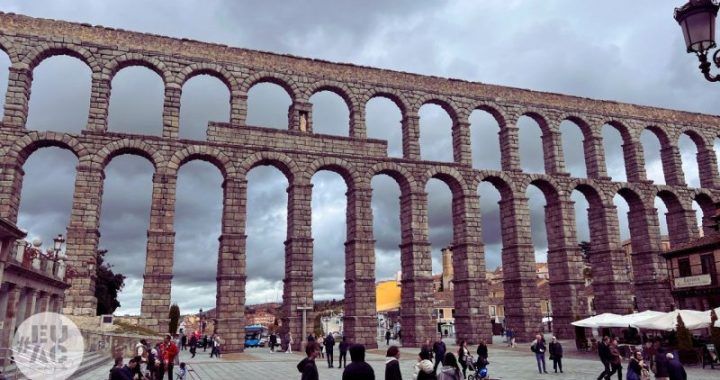
It is the postcard of the city, the image that comes to mind as soon as we think of Segovia.
The most visible part, and therefore famous, is the arcade that crosses the Plaza del Azoguejo and that is where we headed. The aqueduct of Segovia s one of the best preserved works of Roman origin in the world, runs more than 15 km before reaching the city. and is declared a World Heritage Site by the Unesco.
It was built at the beginning of the 2nd century to supply water to the city, and it did so until the 20th century.
You feel small when you stand underneath it, the work is imposing and you spend a lot of time admiring every detail of it.
We chose accommodation very close to it, just a few steps away, so we could admire it at night as well.
Don’t stay alone below, you can climb some steps next to it to be able to observe it from the viewing point in all its majesty.
Taking a free tour of Segovia is something that is worthwhile, this time we chose to walk it on our own but it is something we have done on another visit.
If Segovia had only this attraction it would be worth the visit here, but as it has much more we continue our walk to the Plaza Medina del Campo
House of the Peaks
Along the way on this Juan Bravo street we will find the Casa de los Picos. It is known for its façade, with 617 granite peaks, and for its Renaissance courtyard. This peculiar house is today the headquarters of the School of Art and Superior Design of Segovia. It was built in the 15th century as a fortified house in order to defend the Puerta de San Martín, which was demolished in 1883.
And now if we continue walking towards the
Plaza Medina del Campo
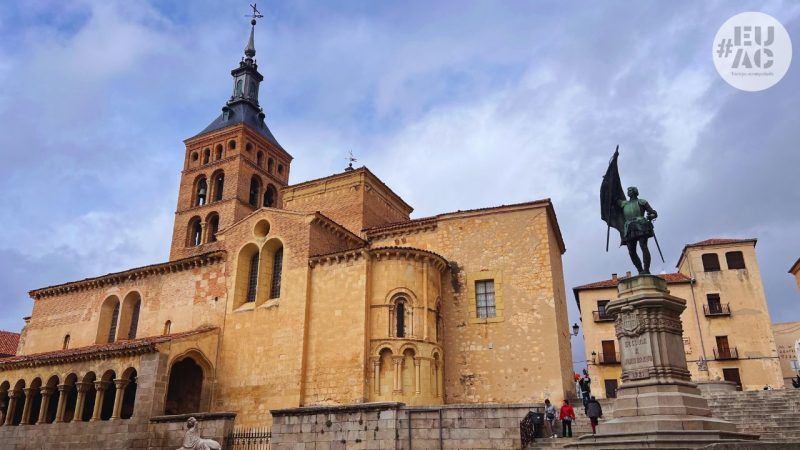
This historic square was the busy center of the medieval city. Here we find the Church of San Martín, the Renaissance house of Solier and the statue of Juan Bravo, which will certainly not go unnoticed on our walk.
We made a stop because it was already past noon, Castilla, the place is beautiful with very nice views, what we tried was very good.
Our steps are directed towards another square
Plaza Mayor of Segovia
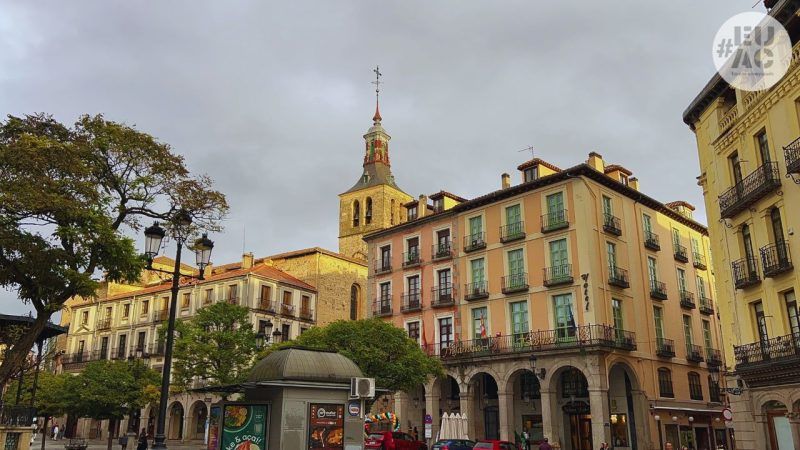
It was historically known as Plaza de San Miguel, in this square was held the market in the city of Segovia and was also the place where Isabel the Catholic was proclaimed queen of Castile in 1474.
Are you planning to visit Madrid?, don’t miss our post on What to see in 3 days in Madrid
In the middle we find a small temple and surrounding it the Juan Bravo Theater, the Town Hall and the Cathedral, a place that we will visit now.
Cathedral of Segovia
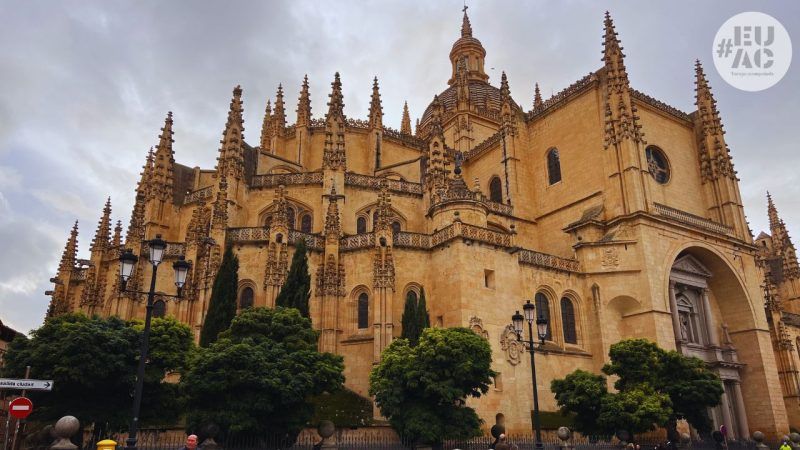
Another of the wonders of this city is its cathedral. The Cathedral of Segovia is known as the lady of the cathedrals due to its size and elegance.
The Santa Iglesia Catedral de Nuestra Señora de la Asunción y de San Frutos de Segovia was built between the sixteenth and eighteenth centuries and is part of the late Gothic style. It is one of the late Gothic cathedrals in Spain and Europe.
Stop to see all the exterior details but it is also worth entering, the entrance fee to Segovia Cathedral is €4. They also have other options for visits, such as guided, tower or night visit. And we leave this essential to see in Segovia to go to another.
Jewish Quarter
From here we will get lost in the old Jewish quarter of Segovia
The urban layout remains practically intact. Between 2005 and 2009, thanks to the implementation of the Historic Centre Rehabilitation Area project, a comprehensive renovation of the Jewish quarter was carried out.
A tour on the tourist bus of Segovia is another good option, and also visit some places a little further away such as the Casa de la Moneda or the Sanctuary of Fuencisla.
And now we will go to another of the essentials in Segovia
The Alcázar of Segovia
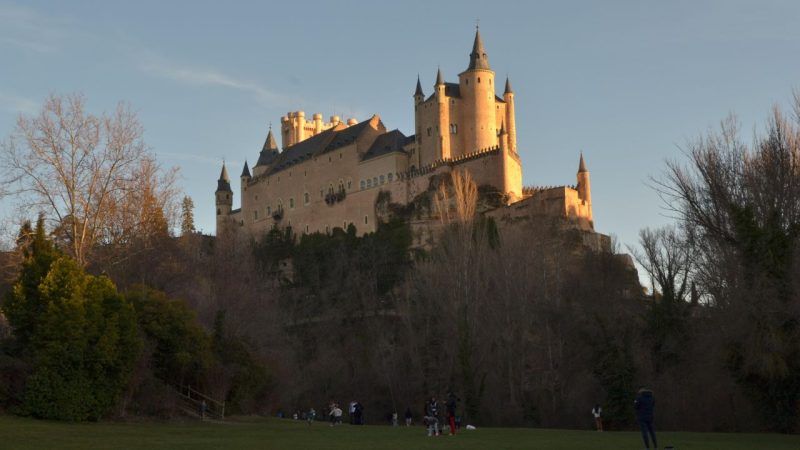
It’s really beautiful. The Alcázar dates back to the early twelfth century, it is one of the most visited monuments in Spain. It has been the palace and fortress of the kings of Castile.
Guided tour of Segovia and the Alcazar
It was declared a World Heritage Site by Unesco in 1985
You can access it, the price of the full ticket including the rooms of the palace, the museum and the climb to the tower is € 10.
Apart from entering it, we will look for the best places to see it in its entirety.
Two of the points from where we can see it are
Mirador de la Pradera San Marcos and Mirador de la Iglesia de la Veracruz, from both points I leave the indication on the map in the blog.
Once in the latter named we will also take the opportunity to visit theI church of Veracruz
Romanesque style was built in 1208 and declared National Monument in 1919. Attributed its construction to the Templars, it is currently believed that it was the Order of the Holy Sepulchre of Jerusalem that built it.
We return to the old center and we will pass through the
St. Andrew’s Gate
The Gate of San Andrés is the most outstanding of the wall of Segovia, it is known as Arco del Socorro, because of the image of the Virgin of Socorro installed there in the modern age. This door had a lot of activity, among other things because it gave way to the Jews who were going to their cemetery and also because the Jews were expelled through it.
Take a selfie with the devil of the Aqueduct
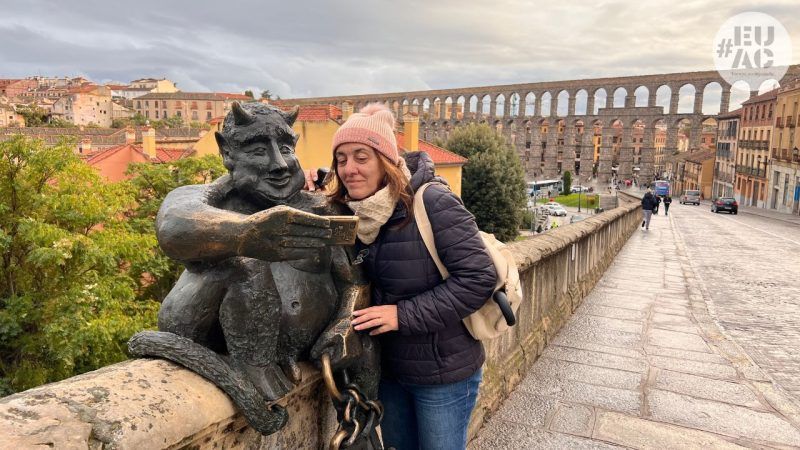
Very close to the aqueduct we find a statue of a devil taking a selfie.
Although this statue has generated quite a bit of controversy, the now famous little devil is part of the photo album of many tourists who come to Segovia to take a photo with the aqueduct.
The story of the devil and the aqueduct is part of a legend and it says that the monumental Aqueduct of Segovia was built by the devil himself. A water carrier, tired of carrying the jug through the streets of the city, accepted a pact with the devil, who offered to build the aqueduct to bring water to her house in exchange for her soul. According to this legend, the devil’s fingerprints can still be seen on the stones of the Aqueduct.
Night had arrived in Segovia and we were enjoying it. It was cold but the walk was worth it. It was time for dinner, maybe to try their famous roast suckling pig and go to rest at our hotel almost at the foot of the aqueduct.
Avila. What to see in the city?
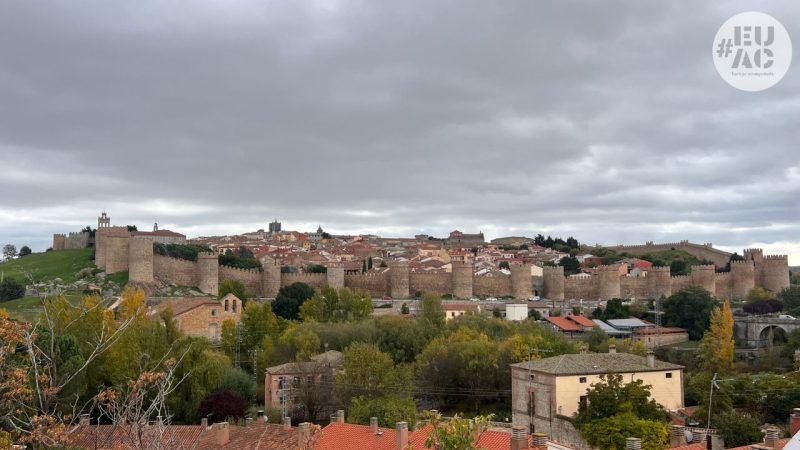
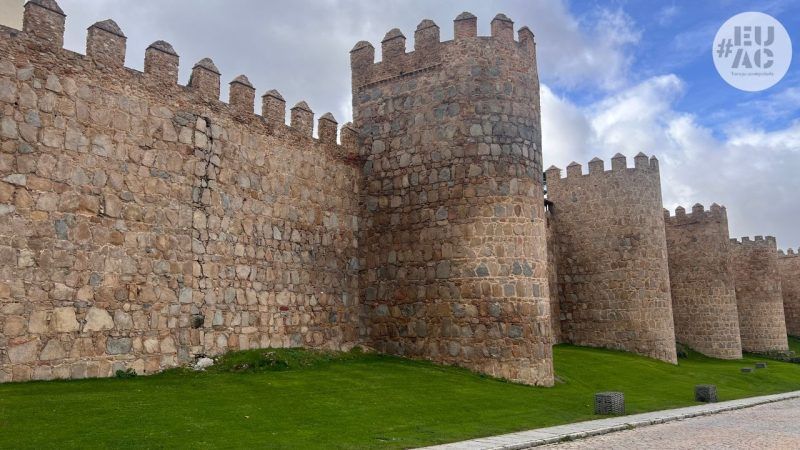
Also located in Castilla y León and just 65 km from Segovia and 110 from Madrid, we find one of the best preserved medieval walled enclosures in Europe, Ávila.
From afar we begin to see this walled city and we are already amazed. I recommend making the first stop before arriving
Viewpoint of the 4 posts
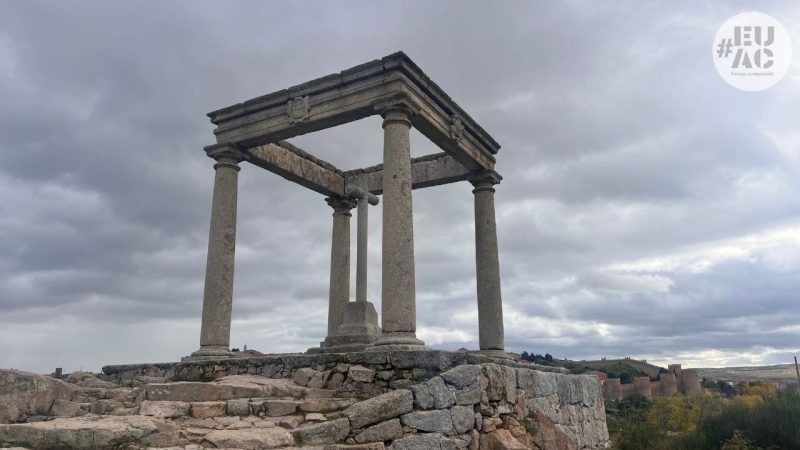
Arriving here at the beginning, before entering the city is ideal to get an idea of the place we will access in a few minutes.
From here you can see the complete image of the city and its wall, a postcard that will remain indelibly in your travel memories.
The 4 posts are a monument built in 1566 formed by four Doric columns and in the center a cross.
Without a doubt it is a unique viewpoint of the city, we find here the name of the city to take some nice photos.
Once seen from afar, we prepared to enter it and live the experience of walking through its streets. But not before surrounding it to see it up close. The wall, along with the old town and several churches outside the walls were declared World Heritage by the UNESCO in 1985.
It has a perimeter of 2 kilometers and 9 access gates.
We will start by entering through the Puerta de San Vicente and our steps will meet in a short time with the
Cathedral of Ávila
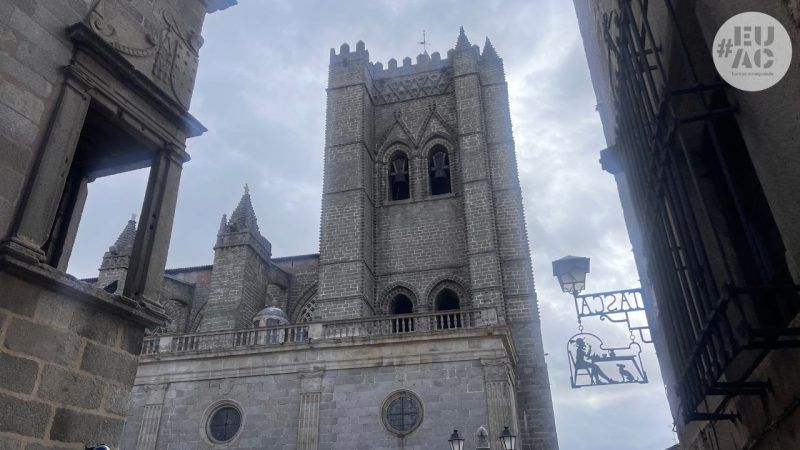
The Cathedral of Ávila is attached to the wall so it was also designed as a fortress.
The Cathedral of Christ the Saviour, built between the eleventh and fifteenth centuries, has a mixture of Romanesque and Gothic styles.
The visit to the interior is worth it, the entrance fee is € 8.
Our steps will be lost within this walled city, until we find the
Plaza del Mercado Grande outside the walls or the Plaza del Mercado Chico within the walls.
Or places such as the Convent of Santa Teresa, the Royal Monastery of Santo Tomás, the palaces or the Basilica of San Vicente outside the walls.
Another good option is to take a free tour of Ávila, it will help you with the historical data of it, I still think that they are always a good option when you do not know the city.
Practical information
Let’s go to the practical information to make the visit to these cities.
We stayed connected thanks to the unlimited internet of Holafly’s eSims, and we traveled with Iati insurance as always. I leave a link to both of them with a discount in the description and in the blog.
To get there from Madrid you can take the fast train, in half an hour you will be in Segovia, the cost per journey is around €14, anyway I leave a search. You can go on the normal train, the journey will be longer but the cost will be lower. Renfe search engine
We have gone by car and as we said we stayed one night in Segovia.
From Madrid to Ávila they do not have a high-speed train so the journey will take approximately an hour and a half and the cost is around 13 euros
They have excursions from Madrid that make Segovia and Ávila, the cost is around 70 euros.
Where do we stay? This time we chose a Eurostar, Eurostar Plaza Acueducto.
The average hotel, nothing to highlight, if the location just a few steps from the aqueduct.
We had dinner at Casares Restaurant, it was super good, very close to the aqueduct too, and I took the opportunity to try the suckling pig roll that was spectacular.
Map and video
NOTE: The information in this article is based on our own experience, being totally objective. This article contains affiliate links