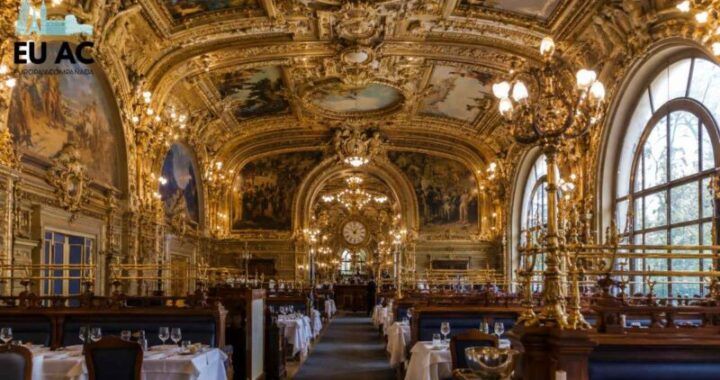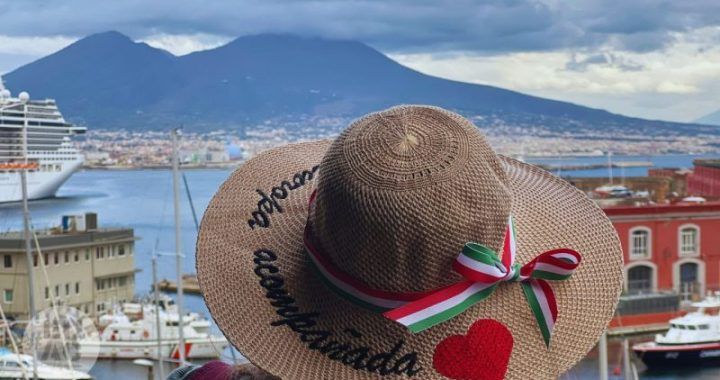
What to see in Naples in four days. A city with personality, there is no middle ground, you either don’t like it at all or you love it, but one thing is certain, it does not go unnoticed, I have no other way to present Naples!
Four-day itinerary. The routes try to link places to form an itinerary without getting desperate in the planning because there are many things to see, not getting tired on the walks and optimizing our time is important to enjoy the city.
Indice:
Day 1 what to see in Naples
Plaza del Plebiscito
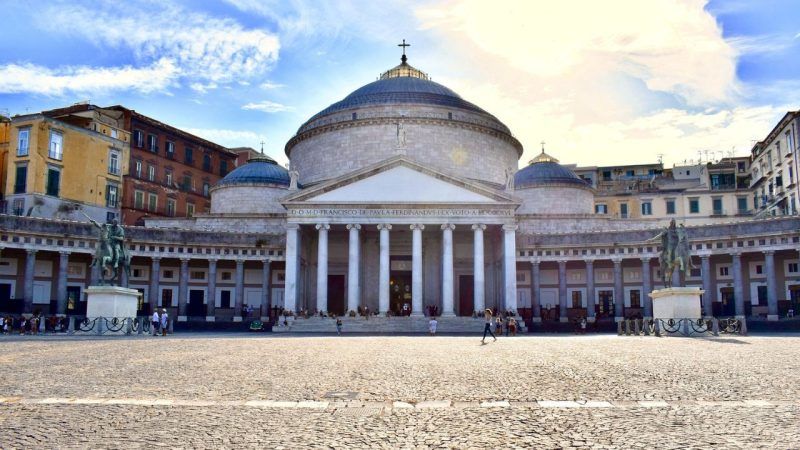
Before going to meet a free tour of Naples we walk through the Piazza del Plebiscito, heart of the city and place where many events of the city take place. This large square lets us see some important buildings such as the Royal Palace, the Basilica of San Francesco di Paola, the Palace of the Prefecture and Palazzo Salerno.
Royal Palace of Naples
Opposite the Royal Palace, palace that we are going to enter in this tour. The palace was built from 1600 and had the function of residence of the Virreyes Spanish. Carlos de Borbón made it, from 1734, the main residence of the Borbons of Naples for over a hundred years. It was also the residence of Joseph Bonaparte and Joaquin Murat during French rule (1806-1815), under which extensive redecorations were carried out. After the Italian unification in 1861 it passed into the hands of the Savoyards.
The staircase is beautiful and if you like palatial halls it is a good visit to make. The price of the full ticket is €15.
Naples Pass museums Campania
Here I stop to tell you that we entered with a tourist pass, the Naples Pass Campania Museums. They have several things included and at least when we used it we did not need to book in advance. With this pass, the Caserta Palace, the ruins of Pompeii, Herculaneum, several other things here in the city are also included, and you can add transportation. But do not confuse it with the Naples Pass, which although they are from the same company, the latter only includes attractions within the city, which is the one we chose.
Umberto I Gallery
Before going to meet a walking tour we would stop very close, just a few steps away, at the Umberto I Gallery.
Built between 1887 and 1890, although it does not maintain the brightness it had, not so many commercial premises are found inside, its structure is still magnificent and is one of the sights to take during walks through this city.
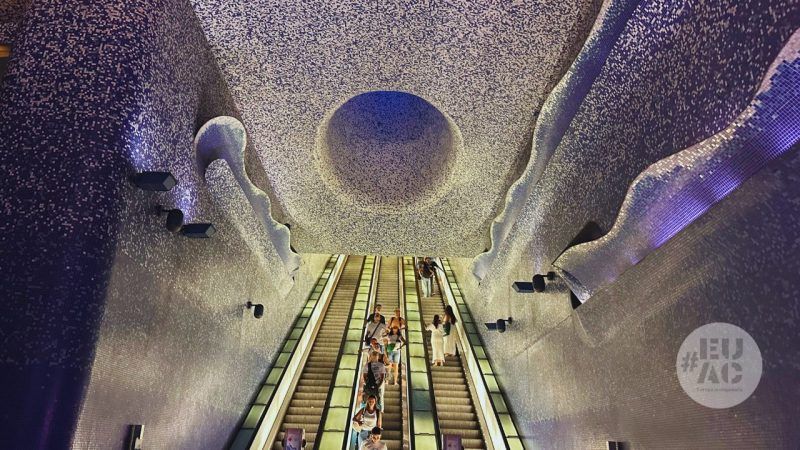
And now we move on to the place where our free tour would begin, about 600 meters further that would take us to Via Toledo, one of the most famous arteries of the city. I would also like to tell you that if you are going to travel by metro, the Toledo station is one to stop and admire its interior, it is very beautiful.
Quartieri Spagnoli, Maradona Mural and free tour
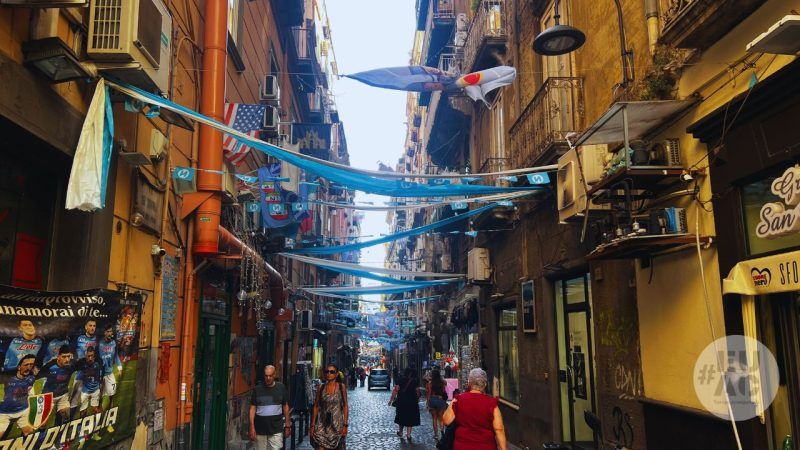
On this first day we cannot miss a free tour of Naples. A Neapolitan guide with perfect Spanish accompanied us in that first encounter with this colorful city, with hanging clothes, altars with virgins, paintings and statues of Maradona in its streets, the perfect combination to not cease to amaze us, added to scooters that seemed to come from everywhere.
For this first day then we would immerse ourselves in the Quartieri Spagnoli, with the essential visit, whether you like soccer or not, being Argentine or not of the Maradona mural.
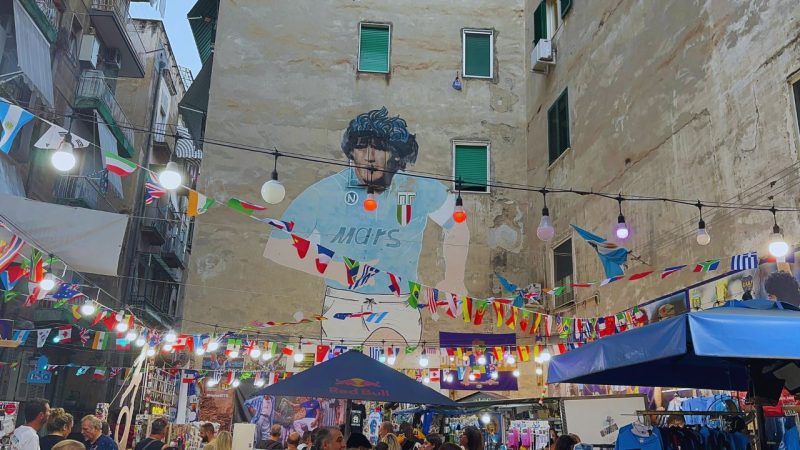
Not being either of those things, I couldn’t help but notice the excitement of everyone upon arriving, or the devotion of many for their football idol. As I said, I think the visit is a must.
We continue walking through this neighborhood and go to Vico Totó street, the famous Neapolitan actor.
Will you visit Rome on your tour of Italy? Don’t miss What to see in Rome in five days
On this tour of Naples and throughout Italy, we use Holafly eSIMs as usual. This time we used the Holafly Italia eSIM but if you are going to make more than one country within the continent the eSim Europe is the right one. I leave you the discount coupon: EUROPAACOMPAÑADA5
Hotel
We had the accommodation a few meters behind Piazza dei Plebiscito so the location was perfect for walking a lot, and also convenient for getting to the port where you can take the ferries to Capri or Procida.
The accommodation is in an old mansion, from the outside it may look neglected as well as the street, as is Naples, but inside it is a little gem, a beauty. It has a garage inside, it is difficult to maneuver to get in because the street is narrow, but not impossible. Real Paggeria was a very good choice for our stay in Naples.
What I am telling you is that in this type of accommodation that does not have a reception, you will not have the comforts that a hotel offers and you have to be clear about that before booking. Always read all the details of the hotel carefully. In this case, yes, it has an elevator, but it is common that in this type of mansions it is not like that. So, look at all those details.
Day 2 What to see in Naples
Today we go to Spaccanapoli which translates as divider of Naples and runs through the heart of the historic center of the city. But it’s more than that, it’s a vibrant area that won’t go unnoticed.
Naples Cathedral
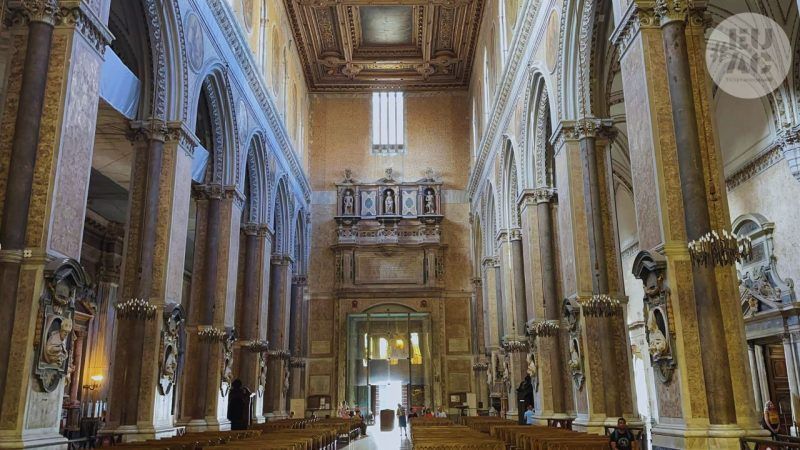
We will start with the Cathedral of Naples and a beautiful area of the city. Here we will link things up in such a way that the total walking distance from the Cathedral until the end of the day will be about 2 kilometers, 2 km and a half.
The Metropolitan Cathedral of Santa Maria de la Asuncion, was built in 1314 where probably, in the ancient times there was a temple dedicated to the god< Apollo. It houses the most ancient baptistery in the West.
With free entry, it is a place not to be missed as its interior is very beautiful. This is a recommendation that I have already given in Rome and that I will surely continue to repeat throughout Italy. There is a cost to enter the baptistery.
A few steps will now take us to the Via dei Tribunali. At 800 meters long, this road is one of the main arteries of Naples.
Enjoying the hike you will be able to find many charming places.

Obelisk to San Gennaro
Thus we arrive at the Obelisk of San Gennaro. This Baroque obelisk dates from between 1636 and 1660. San Gennaro is the patron saint of the city of Naples.
We continue to Piazza Gerolomini, just a few steps away, and we find a graffiti by Banksi, the British street art artist who left this Madonna with a gun in the city of Naples. It is now protected by glass, as part of the artistic heritage of Naples, so that it does not suffer any damage. Here we also find the Girolomini Church.
We continue to Piazza San Gaetano with the obelisk to the saint.
Basilica of San Lorenzo Maggiore
And we also find the Basilica of San Lorenzo Maggiore The Basilica of San Lorenzo Maggiore is one of the oldest in Naples. In its subsoils you can visit archaeological excavations. The entrance fee to visit the basements is € 9.
Via San Gregorio Armeno
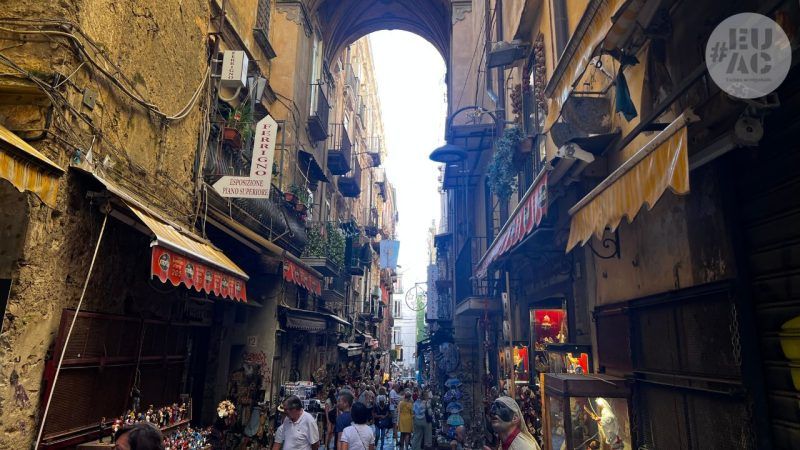
And on this walk we arrive at a very, very particular street, Via San Gregorio Armeno, the street of nativity scenes, nativity scenes, or nativity scenes.
All handcrafted statuettes. The tradition of nativity scenes of St. Gregory the Great has a remote origin: in classical times there was in the street a temple dedicated to Ceres, to whom the citizens offered small statuettes of terracotta. The birth of the Neapolitan manger is naturally much later and dates back to the end of the Eighteenth century.
Today, Via San Gregorio Armeno is known throughout the world as the exhibition centre for the artisan shops located there, which make figurines for the Nativity scenes all year round, but not all of them are religious; we also see countless well-known personalities and characters. On the street you can also visit the Monastery of San Gregorio Armeno.
We now take Via San Biagio dei Librai, this street connects Piazzetta Nilo and Via Duomo. And then we arrive at Piazzetta Nilo

Sansevero Chapel
San Severo Chapel. The San Severo chapel houses works of art such as the Cristo Velado of Giuseppe Sanmartino, famous for the transparency of the marble veil that surrounds the figure of the dead Christ, but as we said it was closed. It is always very crowded so go with time, the entrance fee is € 10.
Church of Pietrasanta. The Water Museum is inside the illustrious Basilica of Pietrasanta. This project takes us on a tour of the Greco-Roman cisterns. We didn’t, as we said we did other subways, the entrance fee is €10.
And we arrive at Piazza Bellini with the monument to Vicenzo Bellini. It is one of the most frequented squares in the city, due to the numerous shops, literary cafes and bars that overlook it. It is surrounded by several university campuses and close to the Academy of Fine Arts
We now cross the Porta Alba, one of the ancient gateways to the city and arrive at Piazza Dante.
Piazza Dante
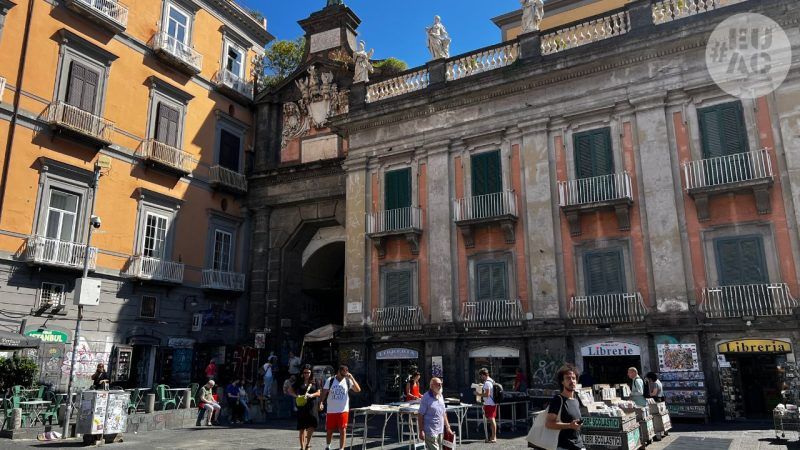
Piazza Dante is one of the most important squares in the city and here begins the Via Toledo that we learned about yesterday. If we go down here to the subway we can also see a nice station.
But this time we will choose to continue walking to Piazza and Chiesa del Gesù Nuovo.
Church of the Gesù Nuovo
In this beautiful Piazza del Gesú Nuovo we find the column of the Immaculate Conception to protect against the plague. And the Church of the Gesú Nuovo, another recommendation to enter, is very beautiful.
Almost opposite the Basilica and Convent of Santa Clara, which has a very nice cloister, the entrance fee is €7.
Day 3 What to see in Naples
Napoli soterranea
Today will be a day of castles, but we will start a few meters from our accommodation with a different visit that we really wanted to do, Napoli Soterranea
The term Underground Naples indicates the very dense and complex network of tunnels and cavities found in the Neapolitan subsoil. The underground city extends beneath the entire historic centre. The tunnels under Naples have been used in various ways over the centuries. Created after the extraction of tuff for the construction of the city, they were used as an aqueduct and also as a shelter during the Second World War.
There are guided tours in Spanish in certain months, we chose to do it in Italian as there were none in Spanish, you also have the option to take it in English, at the time of booking you choose which one. The entrance fee is €12.
Through some stairs you go down about 40 meters deep and you enter a labyrinth of tunnels and cisterns from the Greco-Roman era that dates back more than 2,400 years. The stories and legends that the guide told were very interesting and although it was not in our language, at least I was able to understand him very well.
Although it is not a must-see, we really enjoyed this visit. However, keep in mind the number of steps you have to go down, and that inside you go through some very narrow places, which may not be pleasant for everyone.
Castel Nuovo
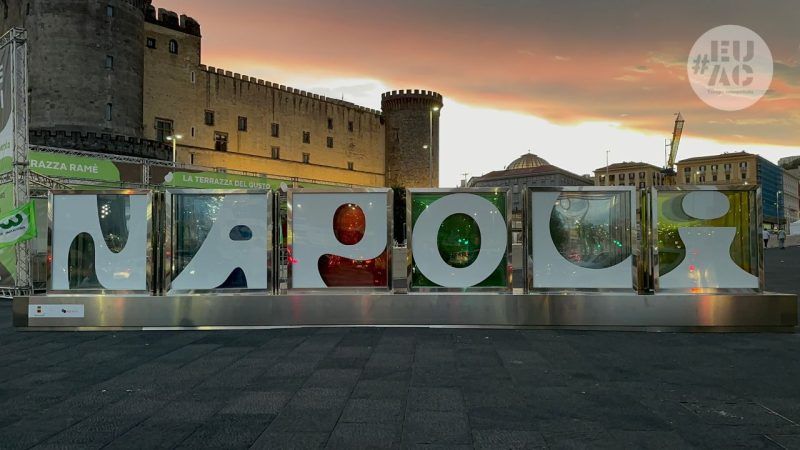
Now on this third day in Naples we go for another of the images that we always have of this city. Castel Nuovo, its port and the views of Mount Vesuvius.
This castle dates back to the time of Charles of Anjou, who after his accession to the throne of the kingdoms of Naples and Sicily in 1266 moved the capital from Palermo to Naples; although the Castel dell’Ovoand and Castel Capuano already existed in the city, Charles arranged the choice of another castle to house his court. In 1279 the construction works began. The entrance fee is €6.
And from here we go to the Molo Beverello, the port of Naples and its promenade A very beautiful area of the city. From this port ferries depart to Capri, Procida and Ischia.
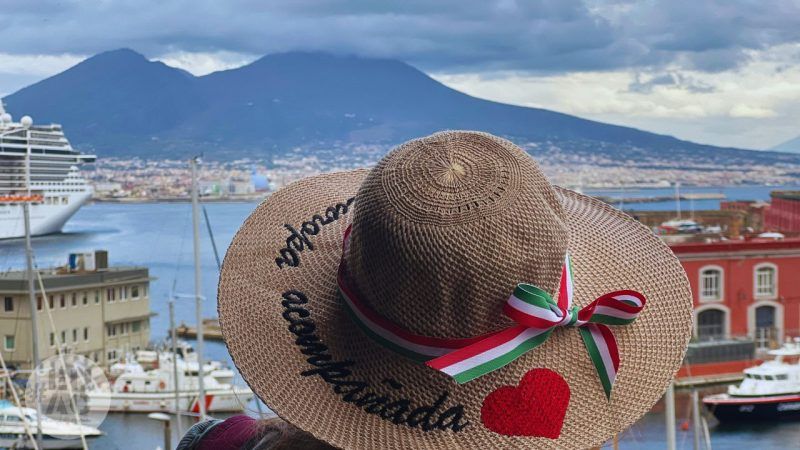
We will now walk along the coast from here to Castel del Ovo. This area with a seafront promenade and views of Vesuvius is very, very pretty and different from what we had been seeing. If you want conventional hotels, this area is ideal for staying, not so much in the hustle and bustle of the network of streets and more decadent, as if we chose to stay there and then we will show you.

Castel dell’Ovo
Castel del Ovo is the oldest castle in the city of Naples and one of the most prominent elements in the panorama of the Gulf of the city. It was built in 1128 and throughout its history has functioned as defensive element, prison, royal residence and center for events and exhibitions. Admission is free.
Next to the castle in the small boat port there are lots of restaurants to enjoy, and like the previous night we returned for dinner.
Castel Sant’Elmo
We are now going for some beautiful views, we will go up to Castel Sant Elmo. You can ride the Montesanto funicular
This medieval castle built on the hill of Vomero dates back to the thirteenth century and is now a museum, housing the offices of the Directorate of the Museum Complex of Campania and the Museum of the Novecento of Naples. If you want to enter the entrance fee is €5 included in the campania pass, if you don’t enter the views from here they are well worth the climb.
Next to it is the Charterhouse of San Martino. It is one of the largest religious monumental complexes and one of the best examples of Baroque architecture in the city. The ticket price is €6
National Archaeological Museum and Capodimonte Museum
If you are still early when you finish these visits, and it is a day when it is open, you can visit the National Archaeological Museum, the most important museum in the world in terms of Roman history, as well as the Farnese collection, one of the richest collections of ancient marbles, and where you will also find, among many other things, objects rescued from Pompeii. The entrance fee is €7 and is included with the Campania Pass.
If you prefer another museum, there is also the Capodimonte Museum, located in the Capodimonte Palace, which has collections of art pieces. The entrance fee is €15 and is included in the Campania Pass, but prior reservation is required.
Day 4: what excursions to do from Naples
If you have an extra day in Naples, the options for visits are many.
Royal Palace of Caserta

Royal Palace of Caserta. Located less than 40 kilometres from the city, it is a gem to discover. We loved it, of course there will be video. You can visit the Palace of Caserta by train with audio-guided tickets. If you get the Campania pass it is included and you do not need to book in advance.
Procida and Ischia
You can visit the island of Procida by ferry, it is beautiful, we loved it and there will be video too of course. We rented bikes and rode it. You can also add the Island of Ischia. There is an excursion from Naples to Procida and Ischia if you don’t want to go on your own.
Capri
Capri is also a good option, ferries depart from Molo Beverello, you can go on your own or on an excursion to Capri.
Vesuvius Volcano
Another different option is to visit Vesuvius. The truth is that seeing this crater up close and the views towards Naples from there is magnificent. There will also be a video with all the details. There are excursions that include it along with our next options. Excursion to Vesuvius and Pompeii
Ruins of Pompeii
It is perhaps the most popular option, visiting the Ruins of Pompeii. We had the entrance included with the Campania Pass as well as the train since we got it with transport. They have excursion in Spanish to Pompeii if it is more comfortable for them.
Ruins of Herculaneum
Visit the ruins of Herculaneum, also included in the Campania Pass, or if you want to go more comfortably, do it on an excursion to Herculaneum.
Amalfi Coast
And also the Amalfi Coast can be a walk, although we did them as a route of several days there is an excursion to the Amalfi Coast for the day if that is the time you have.
When traveling we know that travel insurance is essential, we use Iati during our tours.
My recommendation is not to go by car. We are used to having one all the time because we are doing long trips around the country, but the traffic in Naples is crazy. We also found a public transport strike the day we arrived, which increased the congestion and the chaos. So if you can, don’t do it, but try to arrive at a time when it is not rush hour and have parking at the hotel. We booked a car at Discovercars, I leave a link in the description, generally they have good prices.
We had dinners on the coast two nights at Tratoría Ó Tabbaccaro and at the Quartiere Spagoli the other two, at pizzerias, Pizzeria Laezza and Pizzeria Donna Elvira.
Video & Map
NOTE: The information in this article is based on our own experience, being totally objective. This article contains affiliate links.