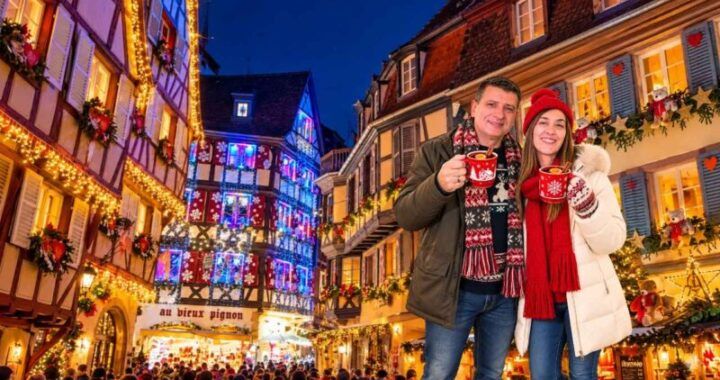
What to see in Colmar is what brings you here surely. Colmar is located in the area of Alsace, France, very close to the border with Germany, in about 20 to 25 kilometers you will be crossing into the neighboring country if you want to do so. Many call it the most beautiful city in the world to spend Christmas and it is the wine capital of Alsace.
Whether you choose it at Christmas or at another time of year, we will see what to see in Colmar, a dreamlike city that seems straight out of a fairy tale.
At Christmas you have tours of the Christmas markets in the Alsace villages, a lovely opportunity to enjoy that magic.
Indice:
La Petite Venise (Little Venice)

We head to the iconic Little Venice. As we saw in the post about the most beautiful villages in Alsace, here we also find countless half-timbered houses in magical colors. The name Little Venice (La Petite Venise) no doubt comes from the original alignment of the houses on both sides of the river.
There are free walking tours of Colmar so you can enjoy it with a guide who will tell you its history and those curious facts that later make us remember a city in a special way.
►Book your spot on the free walking tour of Colmar
Rue de la Poissonnerie

We continue our walk through Little Venice and go for the classic photo we always see of Colmar. From this small bridge on Rue des Écoles we see these picturesque colorful houses that belonged to Colmar’s old fishermen.
Colmar Covered Market
In Colmar everything is very well signposted, so it is very easy to find your way around.
Leaving the fishmongers’ quay, we will enter this market building dating from 1865
A stroll through the market is worth it. You will find fruit, vegetables and cafés, and you can take the opportunity to grab a bite to eat.
There are many typical dishes to try in Alsace. I recommend tarte flambée and baeckeoffe, along with a good Alsatian wine; my favorite is the Riesling variety. You will see glasses with green stems: they are the traditional ones for drinking Alsace wine.
►There are tours from Colmar to visit the villages of Alsace. ►Tour of the villages of Alsace
We now head to the tanners’ quarter
Rue des Tanneurs

The tanners’ quarter. Rue des Tanneurs is the area where the tanners used to live. Most of the buildings are tanners’ houses from the 17th and 18th centuries. They are narrow, deep and tall, and the roofs have many openings where they dried the hides they prepared in the nearby stream.
Old Customs House Square

After a short walk we reach Place de l’Ancienne Douane. This square with its fountain stands opposite the Old Customs House, also known as the Koïfhus, a Gothic and Renaissance building in Colmar. It has been listed as a historic monument since 1930.
Construction of this Gothic building began in 1480, and it became the political and economic center of the city.
We continue our walk through this fairy-tale city.
Very close by we find a curiosity: Colmar’s Manneken Pis, a replica of the famous statue located near the Grand Place in Brussels.
The city of Brussels gave it to Colmar to celebrate the anniversary of the Liberation of Colmar.
Rue des Marchands
We set off along Rue des Marchands, a very lively street full of shops and charming houses. The Christmas shops are open all year round, so, strange as it may seem, you can buy ornaments for your Christmas tree whatever the date.
Pfister House
Built in 1537, the Pfister House is the first example of Renaissance architecture in Colmar. You will spot it right away because tourists surround it taking photographs.
Bartholdi Museum
During the walk you will notice that the route is marked on the cobblestones with triangles as route markers, featuring the Statue of Liberty and the word Colmar.
That is because Auguste Bartholdi, the sculptor of the Statue of Liberty that France gave to the United States, was born here in Colmar.
And so we come to the Bartholdi Museum. Housed in the sculptor’s birthplace, it holds numerous sculptures. Admission is €5. Another museum you can add in Colmar is the Unterlinden Museum, with collections of sculptures and paintings. And the chocolate museum makes for a fun visit.
Although walking around Colmar is very pleasant, there is a small free bus to get around between the sights. The tourist office will tell you where it stops.
St. Martin’s Collegiate Church and Cathedral Square

We arrive at Cathedral Square and St. Martin’s Collegiate Church, whose construction began in 1235.
Dominican Convent
Our route takes us past the Dominican Convent, a former convent built in the 13th century that now houses the Unterlinden Museum.
Maison des Têtes
Another stop on this route is the Maison des Têtes. The House of Heads owes its name to the decoration on its facade, which features 105 masks.
Where did we stay in Colmar?
The hotel we chose for the two days we spent in Colmar was the Hotel Turenne. Located just a few steps from the start of Colmar’s old town, it was a good choice for our taste. But as I always tell you, this is just to show you; you will do your own search and choose the one you think best suits your taste.
Where did we eat in Colmar?
We had dinner at two different places: one was La Petite Venice, very close to the typical houses of Little Venice, and the other was Brasserie des Tanneurs, in the tanners’ quarter.
The food was exceptional at both; La Petite Venice was somewhat more expensive than Brasserie des Tanneurs.
Very close to Colmar there are a number of villages you can visit. They are wonderful, just like something out of a fairy tale. If you want to discover them, check out our post. ↓↓
►The most beautiful villages in Alsace
Town plan, map and video of the places to see in Colmar
►Colmar map from the tourist office
NOTE: the information in this article is based on our own experience and is completely objective. This article contains affiliate links