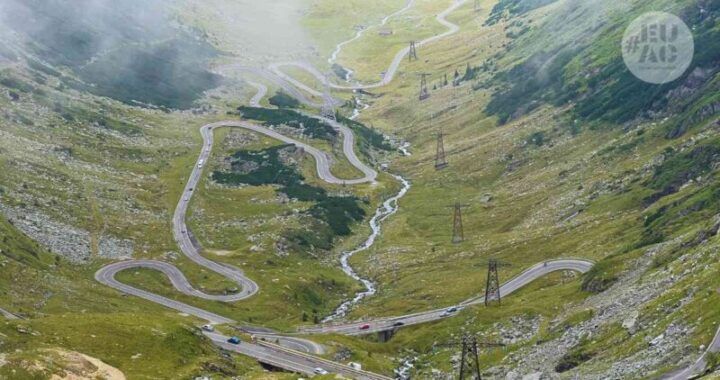
The Transfagarasan Highway is located in Romania, it is the DN 7 C road, it connects the Wallachia region with the Transylvania region crossing the Carpathian Mountains, through the Fagaras Park.
Indice:
Curtea de Arges
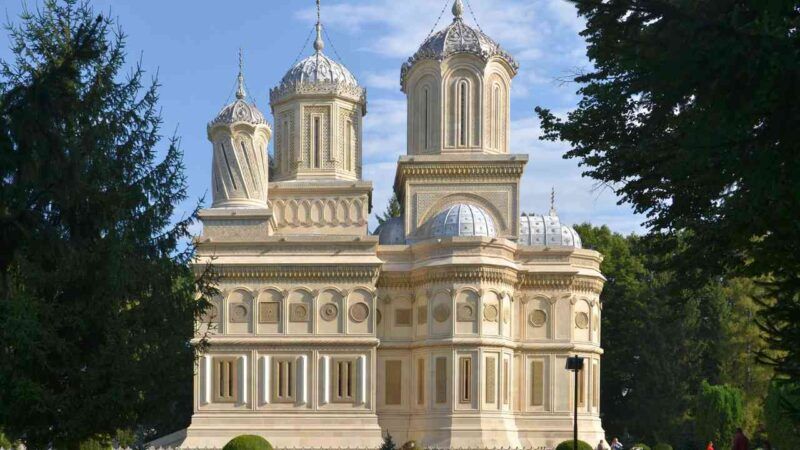
From Bucharest, a city we’ve already covered in a post about everything it has to offer, we head to Curtea de Arges, the first of the places we’ll be stopping at.
The first recommendation we’ll make is choosing the dates, as the Transfăgărășan Highway is only open from late June to October because snowfall blocks the route. We did it in July.
We arrived at Curtea de Arges, the start of the highway. We had traveled 150 kilometers from Bucharest. And now we’re on the DN7C, the Transfagarasan Highway, a road that becomes more and more spectacular as it progresses, and we’ll cover around 90 kilometers..
When we arrived at Curtea de Arges we saw a church, it was San Demetrius, we hadn’t marked it, but it’s one of those things that catches your attention.
In front of us rises the imposing Curtea de Arges Cathedral. This cathedral is not just a monument; it’s the resting place of members of Romanian royalty and the spiritual heart of the Arges and Muscel region. I believe it’s the first obligatory stop on this route.
To travel this route, you need a car. We rented one through DiscoverCars, where we’ve found some great prices lately.
If you don’t want to rent one, you can also take this .Transfagarasan Route tour on a day trip from Bucharest Remember, this is only available from late June to October.
Castillo Poenari
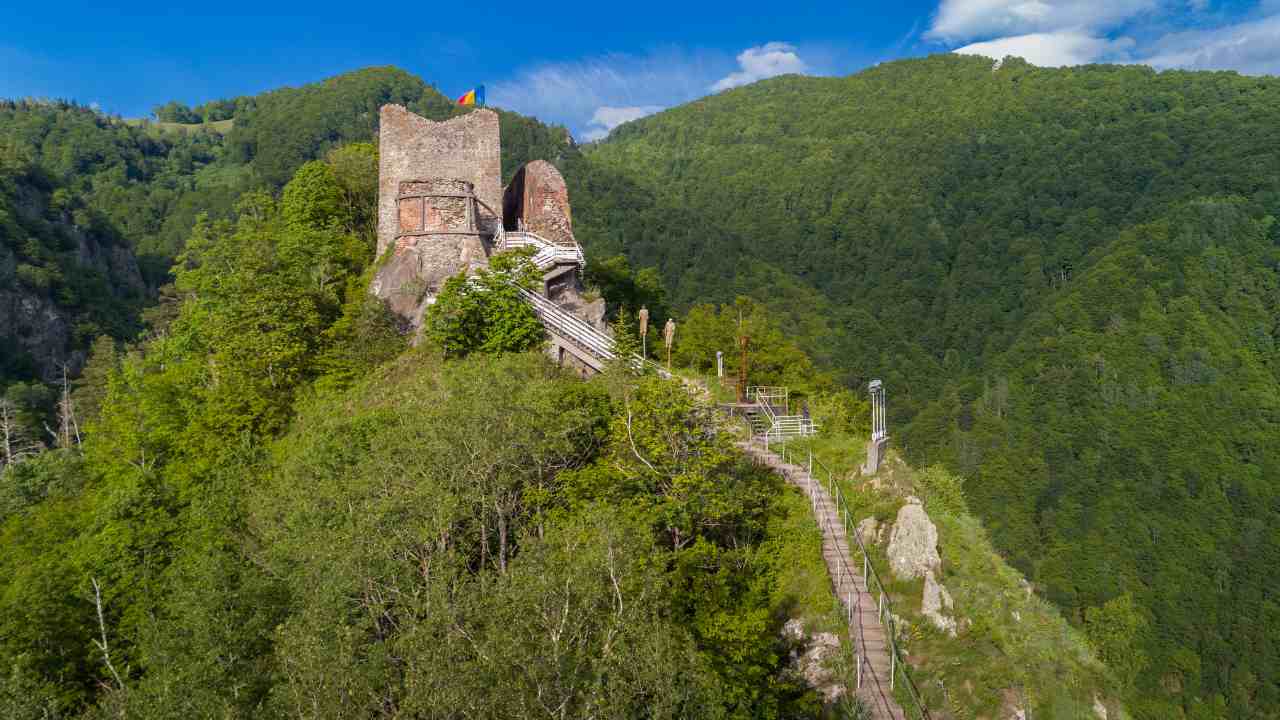
We continue our journey towards a fortress, Poenari Castle, 25 kilometers away.
The total mileage, as we mentioned, from Curtea de Arges to Cartisoara is about 90 kilometers, adding the kilometers you travel to and from each of these points. Plan to dedicate the entire day. The speed limit is obviously very low, around 40 or 50 kilometers per hour. You’ll also stop to appreciate the scenery and make stops for food or drinks, so plan for the entire day.
Perched on a cliff overlooking the Argeș River valley is Poenari Castle, one of the most imposing fortresses in Romanian history. This castle is famous for having been the property of Vlad III, known as Vlad the Impaler, the prince who inspired the legend of Dracula.
Although we didn’t climb to the top, it’s clear that it must be quite an experience to climb its more than 1,400 steps and explore the preserved ruins. What I was saying about dedicating a full day is to consider all the possibilities of activities that open up.
Admission costs 30 lei, about €6, and can be purchased on-site or online. Opening hours are 9 a.m. to 3 p.m.
Signs about not feeding the bears are starting to appear here, which we’ll talk about later, but it’s giving us an indication that we might start seeing them.
Shall we continue our journey along the Transfagarasan Highway? Just 4 kilometers separate us from Lake Vidraru and its dam, one of the wonderful places we’ll see on this tour.
Bears on the Transfagarasan
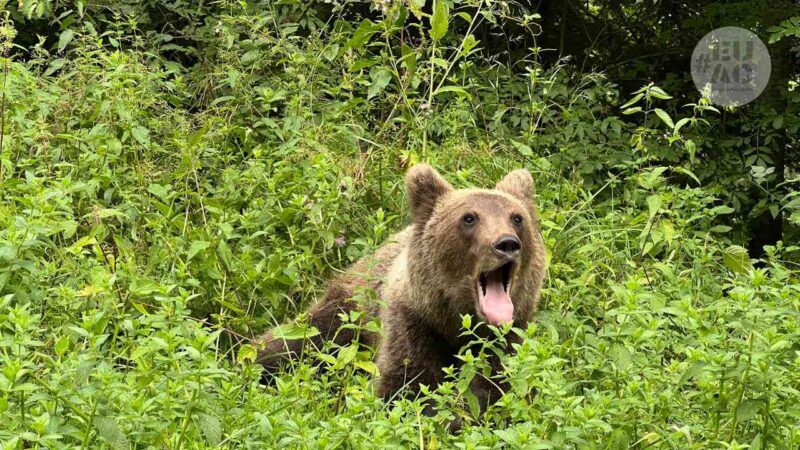
But as we had expected, we found some bears, a female bear with her cub.
Traveling the Transfagarasan isn’t just about admiring mountains and lakes; sometimes, if you’re lucky, you might come across bears on the side of the road. It’s a moving sight: seeing these animals free in their natural habitat reminds us of the grandeur of nature.
But we must be aware: they are not always visible, and we should never approach or attempt to interact with them. Bears are wild, unpredictable, and strong animals, and any contact can be dangerous for both them and us.
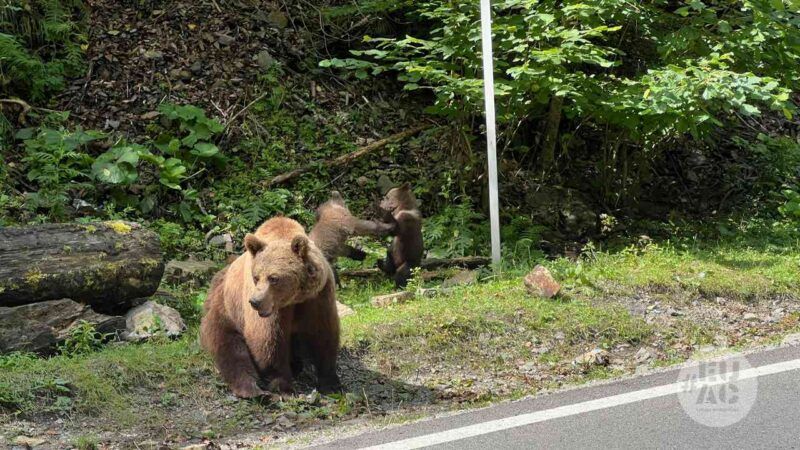
One of the most important things to do is never feed them. Giving them food disrupts their natural habits and makes them dependent on humans. You should also be very careful with your speed and be very alert because they’re on the side of the road. Respecting them means observing them from a distance, enjoying the moment, and letting them continue to live freely in their territory.
Seeing a bear on the Transfăgărășan is a gift from nature, but also a responsibility to protect them. With respect and caution, we can enjoy this encounter without putting our safety or theirs at risk. We were fortunate to see several during the hike, but I must clarify that this is not always the case.
Vidraru lake
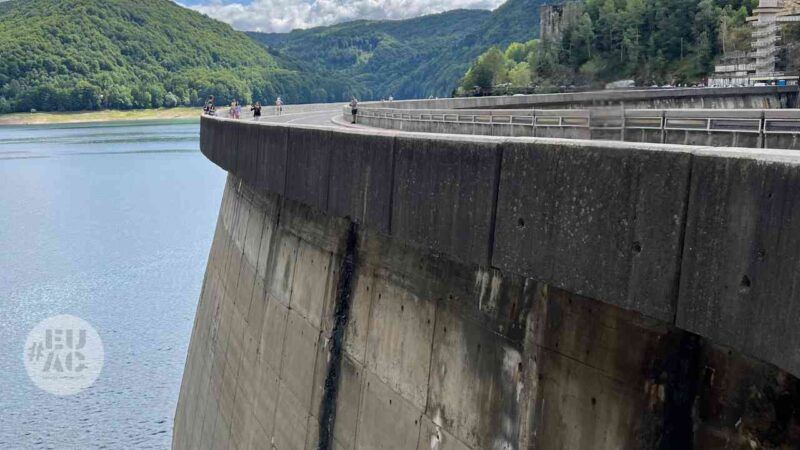
Among the imposing Carpathian Mountains, on the Transfagarasan Highway, lies Lake Vidraru, a spectacular artificial lake created by the construction of the Vidraru Dam on the Argeș River. The dam, completed in 1966, is 126 meters high and is considered one of Romania’s greatest engineering works.
The lake, over 10 kilometers long and with waters reaching depths of up to 155 meters, not only generates hydroelectric power but has also become a stunning tourist destination. From the dam, you can enjoy panoramic views of the Făgăraș Mountains and the valley descending into Wallachia.
There are viewing points and rest stops that allow you to enjoy the scenery and take spectacular photographs. From here, you can observe the magnitude of the work up close, a testament to human ingenuity in the face of the force of nature. If you look up, you’ll see a statue high above. The 10-meter-high statue depicts Prometheus holding a lightning bolt, symbolizing the electricity generated by the dam.
You will know you have reached the Vidraru Lake Dam by the number of people you will find.
Another tip, if you can, is to avoid doing it on weekends because traffic can be extremely heavy and hinder the experience.
Visiting Lake Vidraru is a unique combination of engineering, nature, and adventure, and is a must-see for those traveling the Transfăgărășan and wanting to appreciate the beauty and power of the Carpathians. There is also a nearby inn if you wish to stay.
Shall we continue our journey? The most striking images of this road and its history await us.
Capra Waterfall
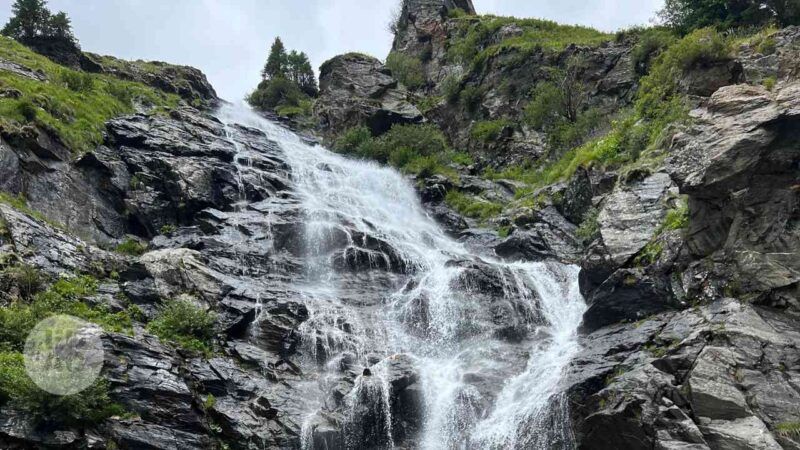
Along the sides you can find places like this one, restaurants, inns, and some cinematic views.
Here’s another tip: bring a coat; the temperature drops significantly in this mountainous area. As I said, we did it in the middle of summer, in the second half of July. We set out in short sleeves, even shorts, and had to stop to take our coats out of our suitcases because we were quite cold.
Taking this route on a motorcycle is a traditional activity, and there are many groups of motorcycles seen along the way.
As we approach our next point, Capra Waterfall begins to come into view, and the route seems small up there, which makes you wonder how far we’ll climb! Several exits to admire the scenery accompany the route. We’ll reach it from the Vidraru Dam, another 48 kilometers.
Capra Waterfall is an impressive waterfall over 40 meters high, originating from Lake Capra in the Făgăraș Mountains. Its constant flow, fed by the melting of nearby glaciers, creates a natural spectacle surrounded by alpine landscapes, a must-see stop on this tour.
Balea lake
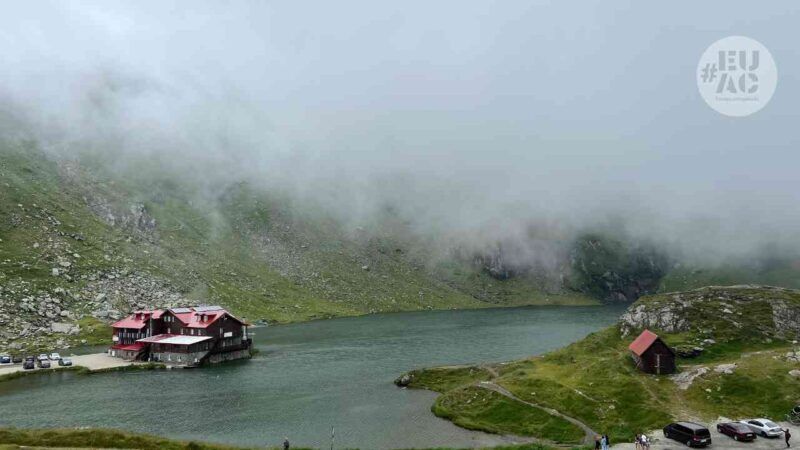
Shall we continue our journey? We’re only 7 kilometers away from our next stop, Balea Lake and something hot to drink.
The vehicle winds through the curves of the legendary Romanian road. Through the windshield, we see the vegetation changing, becoming more alpine.
Before reaching Bâlea Lake, the Transfăgărășan passes through the Bâlea Tunnel. This tunnel connects the southern valley with the upper mountain area, avoiding the steepest slopes and providing access to the lake area. Upon exiting the tunnel, we are greeted by spectacular views of the landscape, numerous tourist attractions, and Bâlea Lake itself, making it an iconic stretch of road.
At 2,042 meters above sea level, Balea Lake emerges like a glacial jewel. Its crystal-clear waters have remained almost untouched for millennia. It’s incredible to think that this lake forms only when the snow melts. In winter, all of this is frozen beneath meters of ice.
The views from here are the most impressive of the route, but both the ascent and the descent are impressive, different, a distinct beauty.
From the valley of the Balea waterfall, a silver line stretches toward the impossible. 3,700 meters of cable and hope that defy gravity. The Balea cable car.
Balea Waterfall
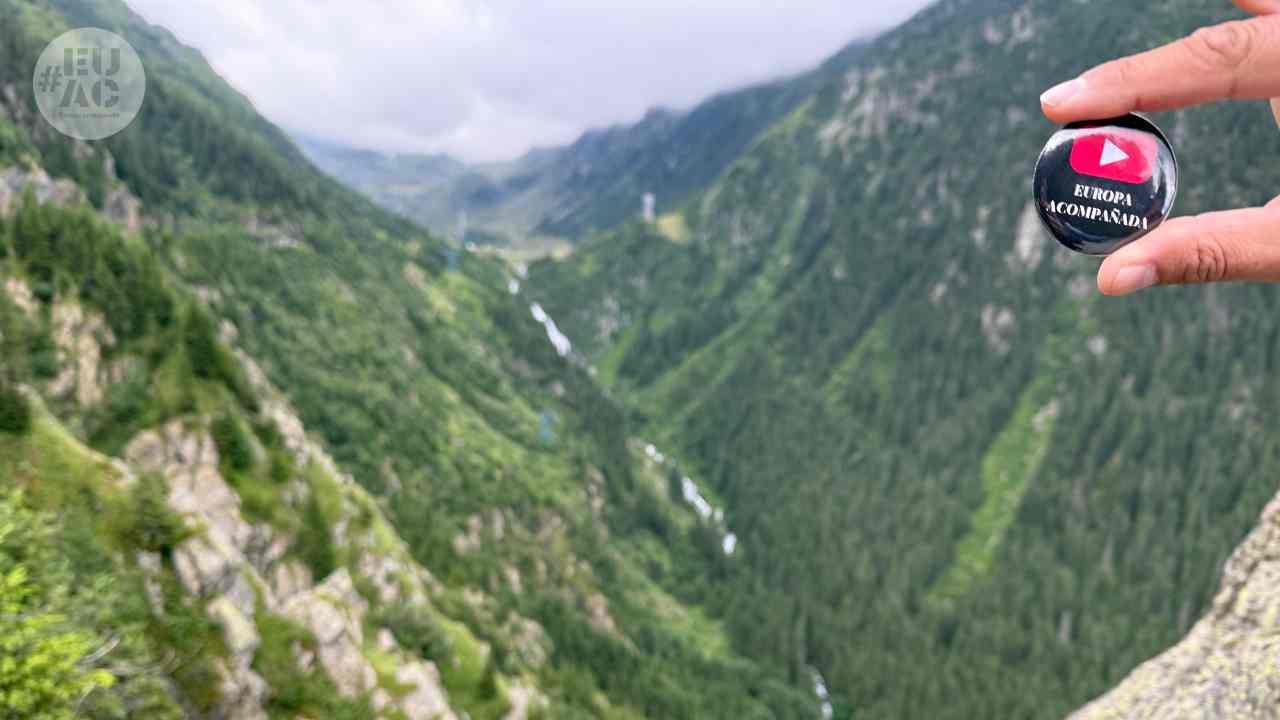
We were now beginning to descend, but contrary to what we thought, the views were once again breathtaking. We thought it was not for nothing that it was considered one of the most scenic roads in the world.
We have about 8 kilometers left to Balea Waterfall, and about 30 to Cartisoara from where we would then continue our journey to Brasov.
For beautiful views of Balea Waterfall, you can stop at a trailhead near Poarta Intalnirii.
History of the Transfagarasan Highway
In 1968, Soviet tanks rolled through the streets of Prague. And in the mountains of Romania, a dictator looked north and felt fear.
Nicolae Ceaușescu understood a terrible truth: his country was cut in two. The Carpathians, that backbone of stone and ice, were an insurmountable barrier. If the Soviets decided to invade, Romania would have no escape to the south.
Thus was born the obsession. A road that would challenge the impossible. A path that would cut through the very heart of the Făgăraș Mountains, connecting Transylvania with Wallachia as never before..
1970 The madness began. Six thousand soldiers, engineers, and workers were sent to conquer the mountain. Dynamite against granite. Human will against untamed nature. For four years, the echo of the explosions resonated in the valleys.
Dozens, or hundreds, some say, were lost in the endeavor. Every curve of the Transfăgărășan is carved with blood and sweat, with dreams of survival and nightmares of the Cold War.
1974 Against all logic, against gravity itself, the road was finished. Ninety kilometers of asphalt winding through heights that touched the clouds. A beautiful scar on the eternal face of the Carpathians.
Today, the Transfăgărășan is no longer a war highway. It’s a pilgrimage route.
The Transfăgărășan not only fulfilled its strategic purpose, but over time it became a symbol of tourism in Romania, attracting drivers, cyclists, and adventure lovers from around the world, who seek to explore its mountainous landscapes and enjoy breathtaking views along the entire route.
The Transfagarasan was coming to an end, we had been in Transylvania for a few kilometers, a region where we would stay for a few days to follow in the footsteps of Dracula, castles and unforgettable landscapes..
Our next stop Brasov, are you coming?
Map of the Transfagarasan route
Download the Transfagarasan Highway itinerary
NOTE: The information in this article is based on our own experience and is completely objective. This article contains affiliate links.